
Transport logistics is a field where no two days are the same. It requires quick reactions, decision-making, the ability to manage unexpected situations, and an overview of the entire supply chain – from the departure of the cargo to its delivery to the final recipient.
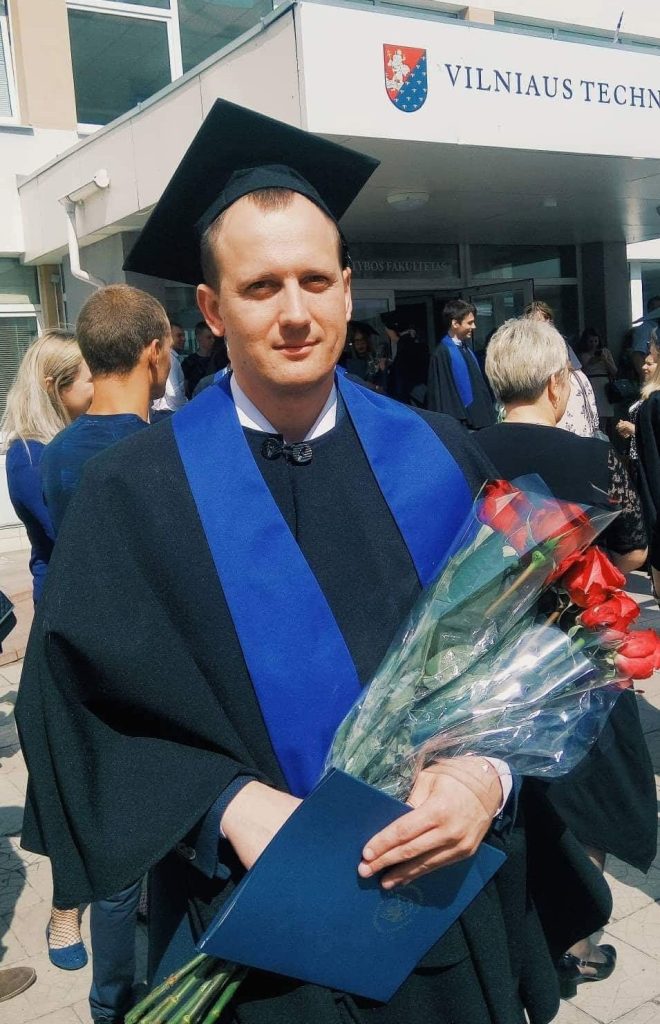
Jan Zajankovski – a graduate of the Transport Logistics degree programme who now works in the international trade of cocoa beans and cocoa products – talks about the dynamics of this profession, the benefits of his studies, the challenges of international trade and his career path. He emphasises that logistics came into his life right at the start of his working career and has, over time, become an integral part of his professional life. Although he had initially chosen to study law, he later realised that he would prefer to link his career path more closely with transport, supply, documentation, warehousing and process management.
Why did you choose to study transport logistics?
Ever since I started working, when I was about twenty, my life has been connected to logistics in one way or another. I’ve always found it fascinating to see how freight, vehicles and other goods travel from one country to another. Logistics seemed like a dynamic and interesting field. Initially, I’d chosen to study law, but over time I realised that this field wasn’t really for me.
At that time, I was involved in the car trade. I remember my first trip to Germany. Back then, there weren’t as many navigation tools, maps or options as there are today. It was all quite straightforward: you’d get on a bus, have a journey, and bring the car back – that in itself was a form of logistics.
Later, I was invited to work at the National Blood Centre and manage the logistics processes. It was then, in 2014, that I enrolled to study logistics. This field was particularly relevant to me, as the Blood Centre served around 60 hospitals across Lithuania, all of which needed to be supplied with blood components. I had to organise transport, vehicles, storage, temperature control and other processes. As my career was increasingly moving towards logistics, I chose this particular course of study.
What were your expectations before you started your studies?
My main expectation was to deepen my knowledge. I already had quite a bit of practical experience, but I wanted to gain a better understanding of the theoretical underpinnings and the legal framework. When you have practical knowledge, you know how things work, but you don’t always understand the reasoning behind them: whether processes are carried out lawfully, and which laws, regulations or international provisions need to be followed. I wanted to gain more systematic knowledge, as logistics is a serious and very broad field. It is important in almost every sector of business, so I viewed this course as an investment in my future.
Did the course live up to your expectations?
Yes and no. There were some topics which, given my previous education, were no longer particularly relevant to me. However, the course helped me gain a better understanding of the logistics system itself, its rules and processes. I particularly value the practical aspect of the course. It was extremely useful to learn about things I hadn’t previously encountered directly: calculations, different modes of transport, container transport, and sea and air freight. Up until then, I’d mainly worked with road transport, so everything to do with freight transport by air and sea was new to me and very interesting. After all, a consignment might be carried part of the way by aeroplane, then shipped by sea, and finally travel the last leg by road. In such cases, it is essential to understand who is responsible for what, what documents are required and how the risks are allocated. This knowledge continues to be useful in my work to this day.
What does a typical day in logistics look like for you?
Logistics and a ‘typical day’ are almost antonyms, because there’s no such thing as a typical day in logistics! My work isn’t just about logistics; it’s more closely related to retail, in which logistics plays a very significant role. That’s precisely why no two days are the same. You might wake up in the morning to find that a container is delayed, a lorry hasn’t turned up, a road is closed somewhere, or a shipment is running late. A typical day in logistics is all about the unexpected! Every day, you wait to see what will happen. Sometimes everything runs smoothly: you book a lorry, the goods are delivered, and the process is completed without a hitch. However, unforeseen situations often arise: something goes missing in the warehouse, the haulier has a ‘flat tyre’, someone is late or makes excuses. That’s why there’s essentially no routine in logistics.
If you prefer a calm, settled job where you can plan exactly what you’ll be doing on a specific day a week in advance, logistics probably isn’t for you. A logistics professional must be prepared for constant surprises.
What are the biggest challenges facing the transport and logistics sector?
From a global perspective, there are several types of challenges. One of the biggest is the shortage of skilled staff. In road transport, for example, we see drivers migrating all over the world. In Lithuania, we have probably already had drivers from almost every country in the world. Due to high staff turnover, it is difficult to manage such processes.
When it comes to maritime transport, in my opinion, a major problem is the monopoly held by shipping lines. There are a few major lines which hold very strong positions and do not always take responsibility. It is difficult for a buyer or seller to argue with them, as there are not many alternatives.
Another challenge of our times is fuel prices. When they rise suddenly, it severely distorts the market situation. Some companies cannot cope, suspend operations or go bankrupt. It is particularly difficult for those companies that have signed long-term contracts at fixed prices. In such cases, costs rise whilst obligations remain the same.
What advice would you give to a prospective transport and logistics student?
First and foremost, they should be inquisitive. It’s also very important to find an area that genuinely interests them. It’s impossible to be a professional in every field – it’s very difficult and only a small number of people manage to do so. That’s why you need to try to find your own niche. Some people are interested in implementing innovations in warehouses, others in working with drivers, planning routes, calculating how cargo will fit into a container or onto a ship, whilst others enjoy dealing with extreme situations.
During your studies, it is important to understand what you enjoy most and to delve deeper into that area. Work placements help with this, as real-world situations provide a completely different experience to theoretical knowledge alone. Whilst you are undertaking the theoretical part of your studies, you should focus on what is closest to your heart.
Can you recall one incident from your professional experience that has stuck with you the most?
One of the most memorable incidents was in 2022, when the onset of a global geopolitical and energy crisis affected almost every sector: energy, raw materials and fuel. It even affected African countries. For about two weeks, shipping, loading and the movement of goods in general came to a standstill. It was unclear what was happening. The transport of raw materials stopped, transport stopped – everything stopped. And yet commitments had already been made. Containers were delayed, carrying cargo worth around 300–400 thousand euros. They were due to arrive at the factory, and the factory had commitments to chocolate manufacturers. It’s an unbroken chain, so we had to work very hard to minimise the consequences. Minor logistical issues crop up all the time, but more serious incidents with major consequences are less common. This situation was one of the most memorable for me.
How do you cope with stressful situations?
First of all, I get about 50–60 grey hairs a minute (smiles). You panic for an hour, then sit down and calmly start to sort things out. The most important thing is to keep a cool head. As soon as you find out about a problem, your initial emotions can be very strong. However, you need to control them, wait, return to a calm state and only then make decisions. You mustn’t make them whilst in an unstable emotional state. Everyone has their own way of calming down: some do sport, others meditate, and others simply go for a short walk. The most important thing is to regain your composure. Solutions always exist. They may be better or worse, but there are always options. It’s important not to think rashly. You need to realise that the situation has already happened; there’s no time machine, so you shouldn’t be thinking about ‘what if’, but rather about how to solve the problem now and what to do to prevent it from happening again.
People often waste a great deal of energy trying to shirk responsibility, rather than devoting all their energy to resolving the situation. In my view, those who shirk responsibility first and foremost cannot become true leaders. A leader is defined by their level of responsibility, not by the duties they impose or the fear they instil in others. A leader takes on the greatest responsibility.
What advice would you give to students thinking of studying transport logistics?
I believe that transport logistics is an interesting and versatile field. It opens up a whole host of opportunities: it allows you to meet new people, get to know a different side of the business world, and see how international trade and supply chains work. I would encourage students not to be afraid to choose this specialism.
Bread will still need to be transported from one country to another somehow. I don’t think teleportation will be invented any time soon, so logistics will always be needed. Cars will have to drive, aeroplanes will have to fly, ships will have to carry cargo, and goods will have to reach people. Cocoa beans won’t grow in Lithuania, whilst some Lithuanian products will be needed in other countries. That’s why logistics will always be relevant. The most important thing is to find your niche, do what you enjoy, discover your area of interest as soon as possible, and deepen your knowledge. Then everything will be fine, because logistics has been, is, and will always be necessary.